
Small Kitchen Storage Ideas That Do Not Waste Counter Space
Small-kitchen storage improves when tools become visible and reachable without occupying the work surface.
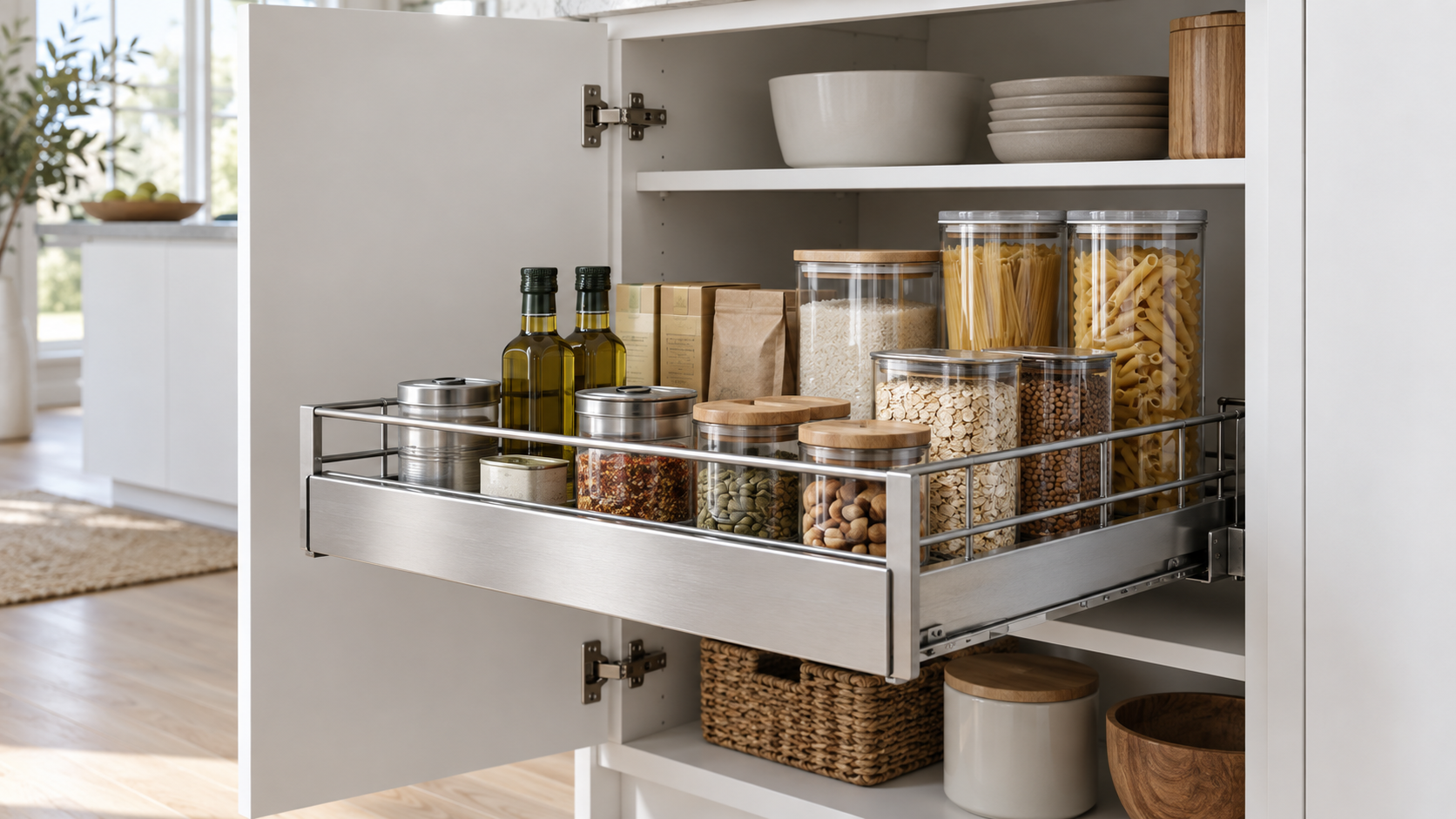
Use vertical and hidden zones
Shelf risers, peg rails, upright dividers, and shallow pull-outs can add access without adding counter clutter. Leave enough clearance to lift the tool out rather than creating a new bottleneck.
Store by sequence
Keep coffee gear together, prep tools near the board, and heat tools near their safe landing zone. Grouping by the next action is more useful than grouping by material.
Measure before buying organizers
Record drawer width, shelf depth, door swing, and the height of the tallest item. A simplehuman-style pull-out can reclaim depth, but only if the mounting surface and runner path are sound.
Store by the next action
Keep the board, knife, and prep bowls close together; keep coffee gear near its water and mug path; keep appliance accessories with the appliance. This reduces the number of cabinet decisions before cooking. Vertical dividers often work well for boards and lids because they prevent a stack from becoming a blocked drawer.
Measure the empty air
Shelf risers and pull-outs use vertical or hidden space, but they need hand clearance. Record the opening, depth, shelf thickness, and door swing. Leave enough empty capacity to remove the item safely; maximum density is not the same as useful storage.
Good storage makes the next action visible
Group tools by the sequence of a task and keep the weekly items at hand. Use vertical zones for boards and lids, shallow drawers for small parts, and pull-outs for deep shelves when the measurements support them. Leave some empty space so the item can be lifted out without moving everything else.
The storage system should survive a busy day
Put the tool used first where it is easiest to reach and the tool used last where it can dry or cool safely. Use vertical storage for flat items and shallow zones for small parts. Do not fill every gap; an organizer that requires a second hand to unpack will not support a quick meal.
FAQ
What should be stored vertically?
Flat boards, sheet pans, lids, and cutting surfaces that are hard to stack and retrieve.
How do I avoid over-organizing?
Start with the items used weekly and leave some empty capacity for safe removal.
Is open storage always better?
No. Open storage improves access but can collect dust and visual clutter; choose the zone that supports the task.
The goal is not maximum storage density. It is a clear next move: see the tool, lift it safely, and return it without unpacking a cabinet.