
Blender vs Food Processor: Which One Do You Need?
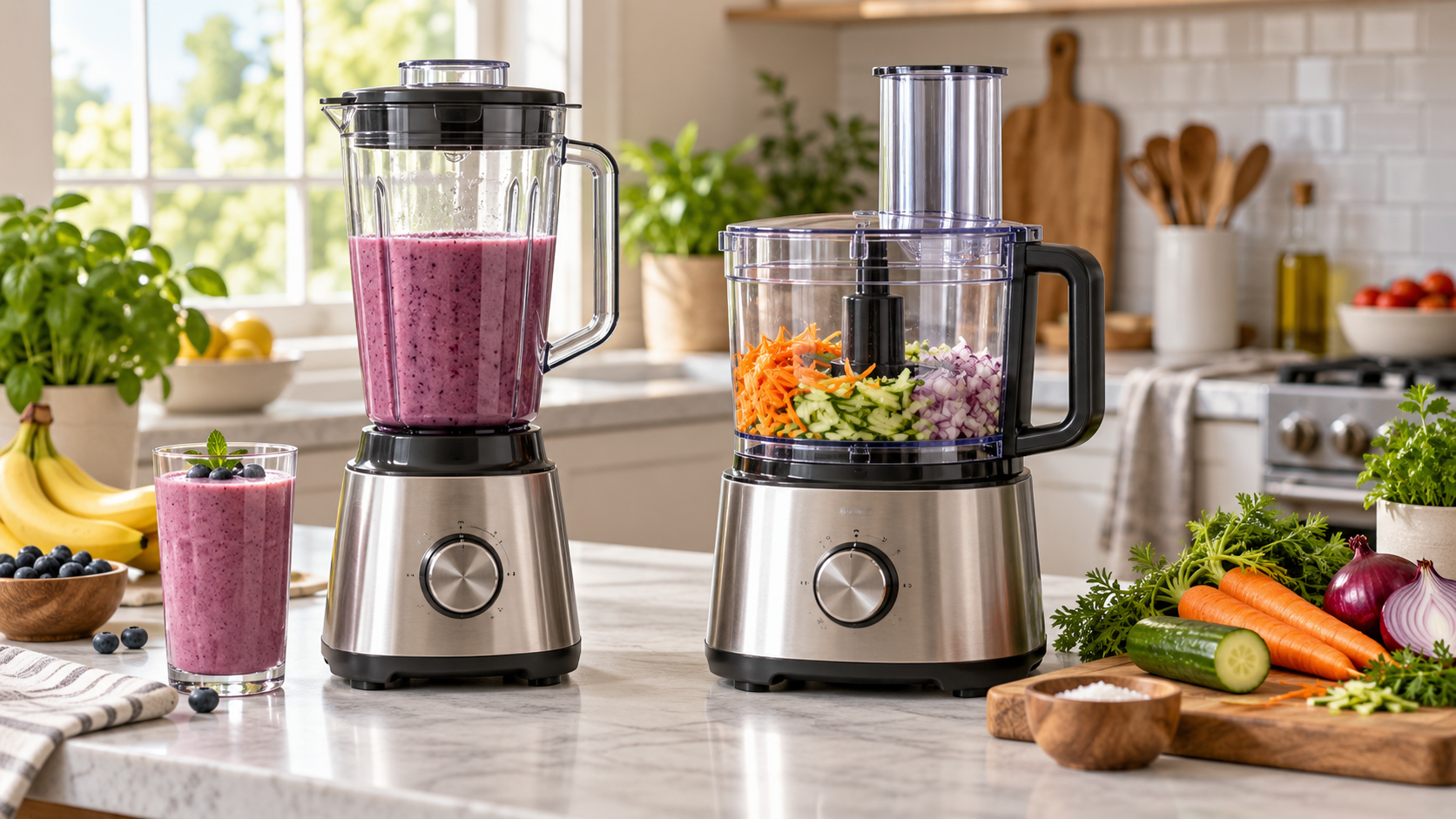
A blender and a food processor may share a motor base and a blade, but their containers point the food in different directions. A blender is built to circulate liquids; a food processor is built to move and cut solids.
The basic difference
A blender uses a tall, relatively narrow jar with a blade at the bottom. Liquid ingredients can circulate down the sides and back toward the blade, which is why smoothies, puréed soups, and pourable sauces are its natural work. A food processor uses a wider work bowl and usually accepts an S-blade plus slicing or shredding discs. Solids move across the bowl instead of being drawn into a liquid vortex.
Why container shape matters
A blender can struggle when a thick mixture cannot circulate or when there is too little liquid. A food processor can chop a pile of vegetables without turning them into soup, but it is not the natural choice for a thin drink. The geometry is a clue to the job each appliance is designed to do.
Common kitchen tasks
Use a blender for smoothies, liquid soups, salad dressings, emulsified sauces, and drinks. Use a food processor for chopped vegetables, salsa with texture, shredded cheese, sliced potatoes, breadcrumbs, and pie dough where the model supports it. Nut butter and hummus depend on the machine, recipe, and required scraping.
Capacity, controls, and cleanup
Blender pitchers are often taller and need cabinet height; food-processor bowls are wider and need drawer space for discs. A blender’s controls are usually speed or program based, while a processor’s key interaction is the blade or disc plus a feed tube. Both need careful blade washing, but the processor adds discs and a pusher to store.
Choose by the food you make
Choose a blender if cold drinks, soups, and pourable sauces dominate. Choose a food processor if chopping, slicing, shredding, dough, or textured dips dominate. Consider both if the household regularly makes both a liquid breakfast and batch prep; buying one appliance to do the other’s job poorly is not a saving.
Common mistakes
Do not add too little liquid to a blender and expect a thick paste to circulate. Do not overfill a processor bowl or assume every disc is included. Do not judge either appliance by motor wattage alone; the vessel, blade, and load determine the result.
The job changes the appliance
A blender’s tall jar encourages a vortex that pulls liquid toward a bottom blade. A processor’s wide bowl lets an S-blade chop solids and accepts discs for slicing and shredding. That geometry explains why a blender is natural for a smooth drink and a processor is natural for vegetables that should keep their shape. The overlap is real, but the best result comes from the tool built around the food’s movement.
Capacity and cleanup are separate decisions
A full-size blender may hold a large soup or smoothie but require cabinet height and careful handling of hot liquids. A processor may offer a wide work area and several attachments but needs storage for a bowl, pusher, S-blade, and discs. If both liquid breakfasts and batch prep happen every week, owning both can be rational; if one task is occasional, rent or hand-prep the exception.
Let the shape explain the answer
The tall blender jar and the wide processor bowl are not arbitrary styling. They create different movement: a liquid vortex versus a broad cutting path. A blender can produce soup and smoothies smoothly; a processor can keep vegetables distinct and use discs for slicing or shredding. When the task is thick or solid, forcing the wrong geometry usually means extra scraping and a poorer texture.
When buying both is rational
Two machines earn their space when a household regularly makes a smooth liquid breakfast and also prepares chopped vegetables, shredded cheese, or pastry dough. If one job happens monthly, choose the tool that handles the weekly job and use a knife, grater, or store-bought shortcut for the exception. Storage for bowls, discs, and lids should be part of the decision.
FAQ
Can a blender chop vegetables?
It can pulse some wet mixtures, but the liquid and tall jar make a uniform dice harder and can quickly produce purée.
Can a food processor make smoothies?
It can process some soft ingredients, but the wide bowl and blade are not designed to create the same liquid circulation as a blender.
Which is better for soup?
A blender is the natural choice for smooth, liquid soup; use hot-liquid guidance for the specific container.
Which is better for shredded cheese?
A food processor with the correct shredding disc is designed for that task.
Do you need both?
Only when both liquid blending and solid prep happen often enough to justify two appliances and their storage.
The shortest answer is task-based: choose a blender for liquid circulation and smooth textures; choose a food processor for cutting, discs, and thicker prep. Own both only when both workflows are genuinely part of the week.